Legacy Java & Spring Modernization

Modernize Legacy Java

Without Rewriting the Business

Implemica modernizes Java-based enterprise systems in controlled stages, including EJB applications, Oracle products, application servers, while preserving critical business functionality.

  • UpgradeJava runtime, Spring, Spring Boot, EJB-based services, application servers, dependencies, build tooling, and Oracle tools foundations.
  • ProtectBusiness behavior, data flows, integrations, deployment continuity, and production operations.
  • OptimizeReduce platform cost and complexity with targeted replacements and safer delivery.

When to call

Common modernization triggers

  • Outdated versions of Java, Spring, Spring Boot, build tools, application-server versions, or EJB dependencies.
  • Enterprise stack on IBM WebSphere, Oracle WebLogic, Oracle Database, or Oracle suites: E-Business, SOA, Forms etc.
  • Security findings, vulnerable dependencies, or audit pressure around outdated components.
  • Delivery risks: slow, manual, or risky deployments, fragile integrations, and limited automated tests that make every release expensive.
  • Performance , scalability, or operational issues that cannot be solved with small configuration changes.
  • Cost optimization for legacy systems: reduce dependence on expensive commercial databases, application servers, and integration platforms, such as Oracle, WebLogic, WebSphere etc., with open-source alternatives.

Scope

Modernization services

Modernization starts with the Java layer and the Oracle stack around it: runtime, EJB usage, application server, Oracle Database, and integration points.

Java and Spring upgrades

Runtime, framework, Spring Boot, dependency, and build upgrades are planned around compatibility and regression risk, including inherited Java EE patterns such as EJB, JSP, JSF, RichFaces, and Struts where they are part of the system.

Cost savings and platform replacement

Where licensing and vendor lock-in are a burden, suitable Oracle and proprietary dependencies can be replaced with open-source alternatives. This can include staged Oracle Database migration to PostgreSQL or MySQL and careful PL/SQL conversion.

Oracle platform remediation

Oracle Database usage, JDBC access, stored procedures, schemas, and Oracle middleware dependencies are reviewed before compatibility breaks become release blockers.

WebSphere and WebLogic modernization

Legacy application-server setups, deployment descriptors, classloading issues, and container assumptions are addressed for IBM WebSphere and Oracle WebLogic environments.

Oracle suite modernization

Oracle E-Business Suite, SOA Suite, Forms and Reports, and similar products can be upgraded or surrounded with safer integration and deployment boundaries over time.

How it works

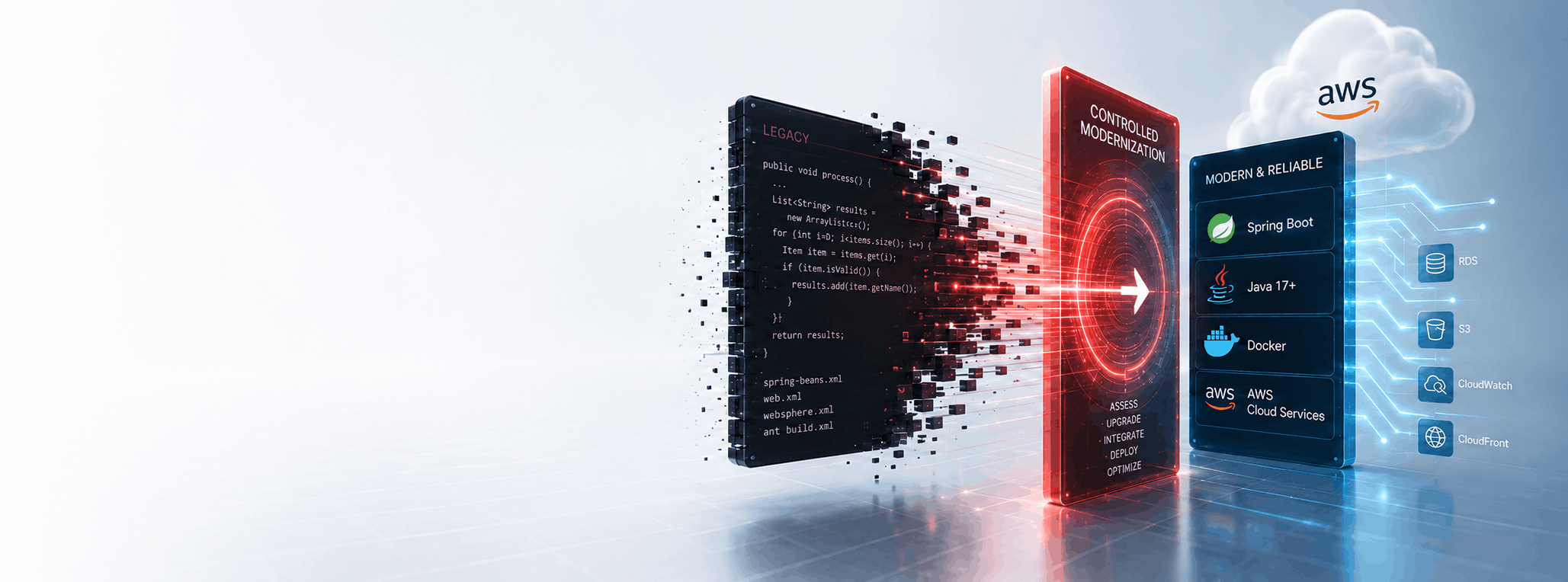
Incremental modernization approach

The safest path is usually a sequence of small, testable changes that reduce risk in the Java, app server, Oracle, and integration layers first.

  1. 01

    Assess first

    Code, runtime, dependencies, build, deployment, tests, and Oracle or WebSphere/WebLogic constraints are reviewed together.

  2. 02

    Map the estate

    EJB modules, JSP or JSF user interfaces, legacy component libraries, Oracle Database touchpoints, shared libraries, middleware, and deployment descriptors are traced before any migration work starts.

  3. 03

    Add protection

    Critical behavior is covered with tests, monitoring, or deployment safeguards before deeper changes are made.

  4. 04

    Migrate in stages

    Runtime, framework, app-server, database, and architecture improvements are delivered in controlled increments.

  5. 05

    Retire the legacy path

    The roadmap is adjusted as risks are retired and the system moves toward a supported runtime, database, or deployment target.

Engineering fit

Rewrite versus incremental modernization

A rewrite is not the default

Working business behavior is valuable. Replacing it wholesale can create new risk before old risk is understood.

Modernization follows evidence

Implemica looks at defects, dependencies, deployment pain, production incidents, architecture constraints, and team capacity across Java, Spring, EJB, WebSphere, WebLogic, Oracle Database, and related enterprise systems.

The roadmap remains executable

Recommendations are tied to implementation steps that can be delivered by Implemica, your team, or both.

EDC Technology

Reliability during modernization

EDC Technology keeps attention on critical functions and failure-prone flows. During modernization, this helps avoid spending effort on cosmetic rewrites while the most important operational risks remain unprotected.

Explore EDC Technology

Outputs

Common deliverables

  • Modernization roadmap
  • Dependency and risk report
  • Target architecture notes
  • Phased implementation plan
  • Upgraded application components
  • Improved build, deployment, and operations documentation

FAQ

Questions technical buyers usually ask

Do we need to rewrite the application?

Not by default. Implemica first evaluates whether targeted modernization can reduce risk while preserving working business behavior.

Can you upgrade a system while it remains in production?

Yes, when the architecture and release process allow it. The work is planned around staged changes, testing, deployment safeguards, and rollback options.

Can modernization be performed module by module?

Usually yes. Module-by-module work is often safer for monoliths, integrations, and large Java systems with critical business behavior.

Can you modernize EJB and Oracle Database heavy systems?

Yes. EJB-based services, Oracle Database integrations, and application-server dependencies can be upgraded and phased carefully to preserve business behavior.

How do you estimate a legacy system?

The estimate starts with discovery: code structure, dependencies, runtime versions, tests, deployment, integration points, Oracle Database usage, application servers, and known incidents.

Can you work with our internal developers?

Yes. Implemica can lead the modernization, support your team, or take responsibility for selected parts of the system.

Discuss your system
with Implemica.