Telemetry ingestion and data sinks
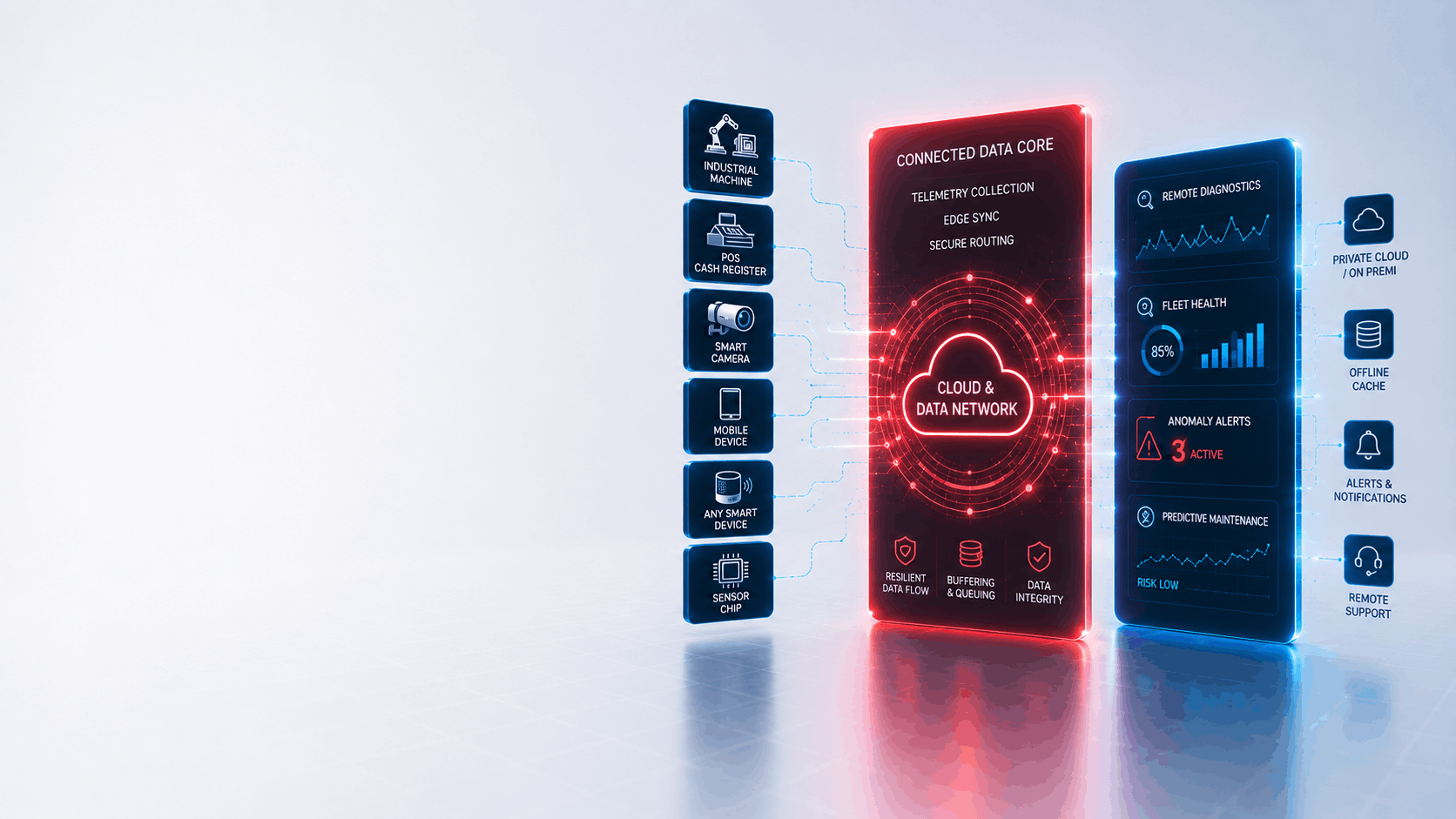
High-volume APIs and event pipelines receive sensor, status, location, uptime, and fault data from large device fleets.
IoT Fleet Management & Predictive Maintenance
For Industrial Fleets and Hardware Products
Implemica builds secure IoT, telemetry, remote diagnostics, and predictive maintenance platforms for manufacturers, service teams, and operators managing connected devices at scale.
When to call
Scope
The goal is not only to collect device data. The goal is to make fleets observable, supportable, secure, and cheaper to operate.
High-volume APIs and event pipelines receive sensor, status, location, uptime, and fault data from large device fleets.
Support teams can inspect device state, guide customers, review alerts, and reduce expensive on-site visits.
Historical and near-realtime telemetry is used for anomaly detection, health scoring, failure prediction, and service planning.
Shared cloud, private cloud, hybrid, and on-premise options can be designed for sensitive industrial or customer data.
Local cache, batching, sync, and edge processing keep systems useful even when device connectivity is unreliable.
How it works
Connected hardware projects work best when software architecture follows operational reality: data volume, failure modes, field support, and security constraints.
Device types, protocols, telemetry frequency, data sensitivity, deployment environments, and support workflows are clarified.
The data reception layer, local buffering, retry behavior, storage model, and access control are designed together.
Dashboards, alerts, health signals, service workflows, and customer-facing views make telemetry operationally useful.
Anomaly detection, predictive maintenance, consumables forecasting, and AI-assisted support can be layered onto reliable data.
Performance, cost, regional deployment, security, data retention, and on-premise options are tuned as the fleet grows.
Engineering fit
The team has built platforms for industrial machines, smart cameras, marine fleets, and telemetry-heavy systems.
Architectures can include tenant isolation, encryption, IP restrictions, rotating keys, private cloud, and on-premise storage.
Offline operation, local cache, batching, retries, and resilient synchronization are treated as core requirements.
Telemetry is connected to support queues, alerts, maintenance actions, warranty workflows, dashboards, and reporting.
EDC Technology
EDC Technology helps identify which signals, device states, support actions, and communication paths are critical. That focus is useful when deciding where to add duplication, fallback behavior, local cache, alerts, and recovery paths.
Outputs
Public proof
FAQ
Yes. Implemica can work with existing devices, protocols, gateways, telemetry formats, and support workflows.
Yes. The architecture can combine standard IoT protocols, REST APIs, local caches, gateways, and custom adapters.
Yes. Offline cache, batching, retry behavior, local processing, and delayed synchronization can be designed into the platform.
Yes. Deployment can support shared cloud, customer-owned cloud, hybrid setups, or on-premise storage for sensitive data.
Yes. Predictive maintenance depends on telemetry quality and history, but anomaly detection and health scoring can be introduced in stages.
Yes. Fleet operators, support teams, dealers, customers, and administrators can receive separate role-based interfaces.