
Technical discovery
Codebase, architecture, build, deployment, infrastructure, data flows, and third-party integrations are reviewed together.
Enterprise Software Rescue & Stabilization
Take Control Without Forcing a Rewrite
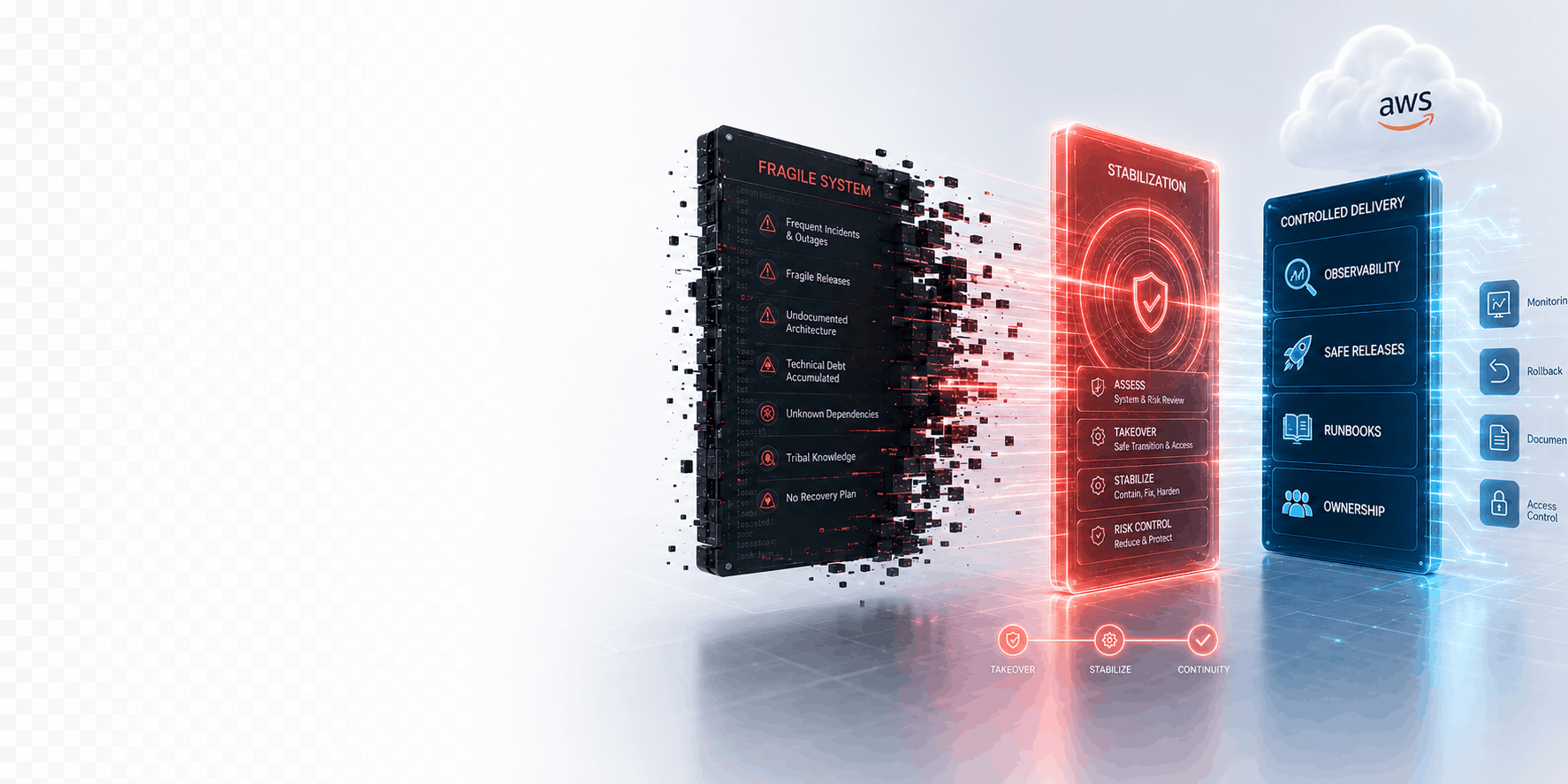
Implemica helps companies take over, understand, stabilize, and safely continue development of complex Java, Spring, and AWS systems when the existing team, architecture, or delivery process is no longer reliable.
When to call
Scope
The first goal is not to rewrite. The first goal is to reduce uncertainty, restore operational control, and make delivery safer.
Codebase, architecture, build, deployment, infrastructure, data flows, and third-party integrations are reviewed together.
Critical incidents, fragile release steps, missing monitoring, and operational failure points are prioritized first.
Unsupported components, vulnerable dependencies, weak configuration practices, and risky access patterns are identified.
Architecture notes, operational procedures, runbooks, and backlog priorities are rebuilt from the current system.
After the high-risk areas are visible, Implemica can continue development with safer release and support routines.
How it works
A rescue engagement should reduce risk from the first weeks of work, not create another open-ended assessment.
Access, environments, source control, deployment paths, architecture, and current incidents are mapped.
Production-impacting failures, logging gaps, monitoring blind spots, and unsafe deployment routines are addressed first.
Critical dependencies, brittle integrations, missing tests, and unsupported components are ranked by business impact.
Changes move through a more predictable backlog, review, testing, deployment, and rollback process.
The system can move into ongoing development, maintenance, reliability work, or modernization in stages.
Engineering fit
The team works with enterprise backends, integrations, cloud infrastructure, and production support realities.
The engagement is built around making the system safer, not handing over a report that nobody has capacity to execute.
Legacy systems rarely arrive with perfect documentation. The work is structured to recover context while protecting production.
Implemica focuses on critical operations, failure modes, observability, recovery paths, and business continuity.
EDC Technology
Implemica uses EDC Technology to reason about Integrated Reliability: expertise around critical points, duplication of failure-prone elements where appropriate, and critical settings that protect important operations. On a rescue project, that mindset helps separate urgent business risk from ordinary technical debt.
Outputs
Public proof
FAQ
Yes. The takeover starts with discovery, access review, source control and deployment mapping, architecture reconstruction, and risk prioritization.
No. A rewrite is considered only when it is justified by business and technical risk. The default approach is to stabilize first and modernize in controlled stages.
Yes. Implemica can support an internal team, take responsibility for selected subsystems, or transition toward broader ownership.
The first work is observational and controlled: understanding access, environments, deployments, incidents, and failure points before changing production behavior.
Yes. Stabilization can lead into maintenance, feature delivery, modernization, reliability engineering, or production support.
Typical access includes source repositories, deployment documentation, infrastructure overview, logs or monitoring views, issue history, and conversations with relevant engineers.