
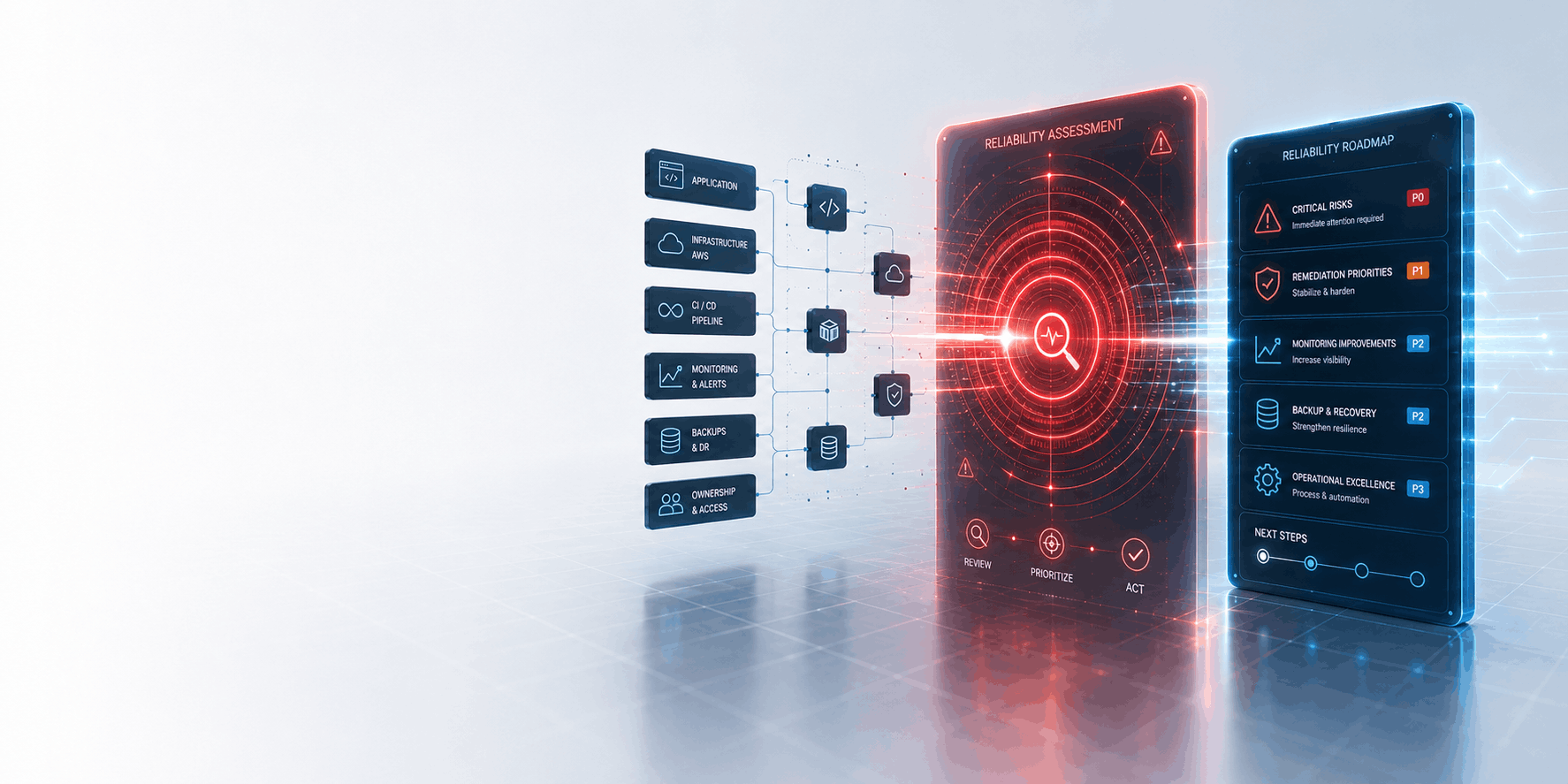
Architecture and application code
Critical flows, coupling, failure points, dependency risk, test coverage, and maintainability are reviewed.
Software Reliability Assessment
Before They Become Production Incidents
A structured review of your application, architecture, AWS infrastructure, deployment process, monitoring, and operational dependencies, followed by a prioritized remediation roadmap.
When to call
Scope
The assessment looks at the system as it actually runs: not only code quality, but also production behavior, operational dependencies, and recovery paths.
Critical flows, coupling, failure points, dependency risk, test coverage, and maintainability are reviewed.
Hosting topology, configuration risks, scaling assumptions, backups, data protection, and recovery paths are examined.
Builds, release steps, rollback options, environment drift, and manual operational dependencies are evaluated.
Observability coverage, incident signals, logs, metrics, alerts, and response workflows are checked for blind spots.
Documentation, key-person dependency, production access, support routines, and knowledge concentration are reviewed.
How it works
The process is designed to create an actionable view of risk without requiring a disruptive production change.
Business context, current concerns, system boundaries, and assessment priorities are clarified.
Relevant access, diagrams, repositories, deployment notes, incident history, and monitoring views are gathered.
Architecture, code, infrastructure, CI/CD, monitoring, data protection, and recovery paths are analyzed.
Relevant team members help identify hidden dependencies, recurring incidents, and operational realities.
Risks, quick wins, remediation options, and implementation priorities are discussed with technical and business stakeholders.
Engineering fit
Your team can use the prioritized findings and roadmap to plan its own remediation work.
Implemica can help with targeted fixes, monitoring, deployment improvements, modernization, or reliability engineering.
If the system needs broader support, the assessment can become the first step toward long-term maintenance or rescue work.
EDC Technology
EDC Technology starts with expertise around critical points in the system and the software product. In an assessment, that means identifying which functions, integrations, and operational conditions matter most for reliability before recommending duplication, safeguards, or critical settings.
Outputs
Public proof
FAQ
No. The assessment can identify security-related engineering risks, but it is not presented as a formal penetration test, certification, or compliance audit.
Not always. The access model depends on the system and risk profile. Read-only evidence, staging access, monitoring views, diagrams, and engineer interviews may be enough for an initial review.
Yes. Java, Spring, AWS infrastructure, CI/CD, monitoring, integrations, and operational ownership can be reviewed together.
Yes. Findings are organized by severity, impact, likely remediation effort, and relevance to business continuity.
Yes. The assessment is useful even if your internal team performs the implementation.
Yes. Implementation can be scoped as targeted remediation, modernization, reliability engineering, or ongoing support.
Yes. It can help clarify technical and operational risk before migration planning, scaling, handover, acquisition review, or a major release.